
Is Jumping Rope "Better" Than Running? (And Why We Should Stop Asking)
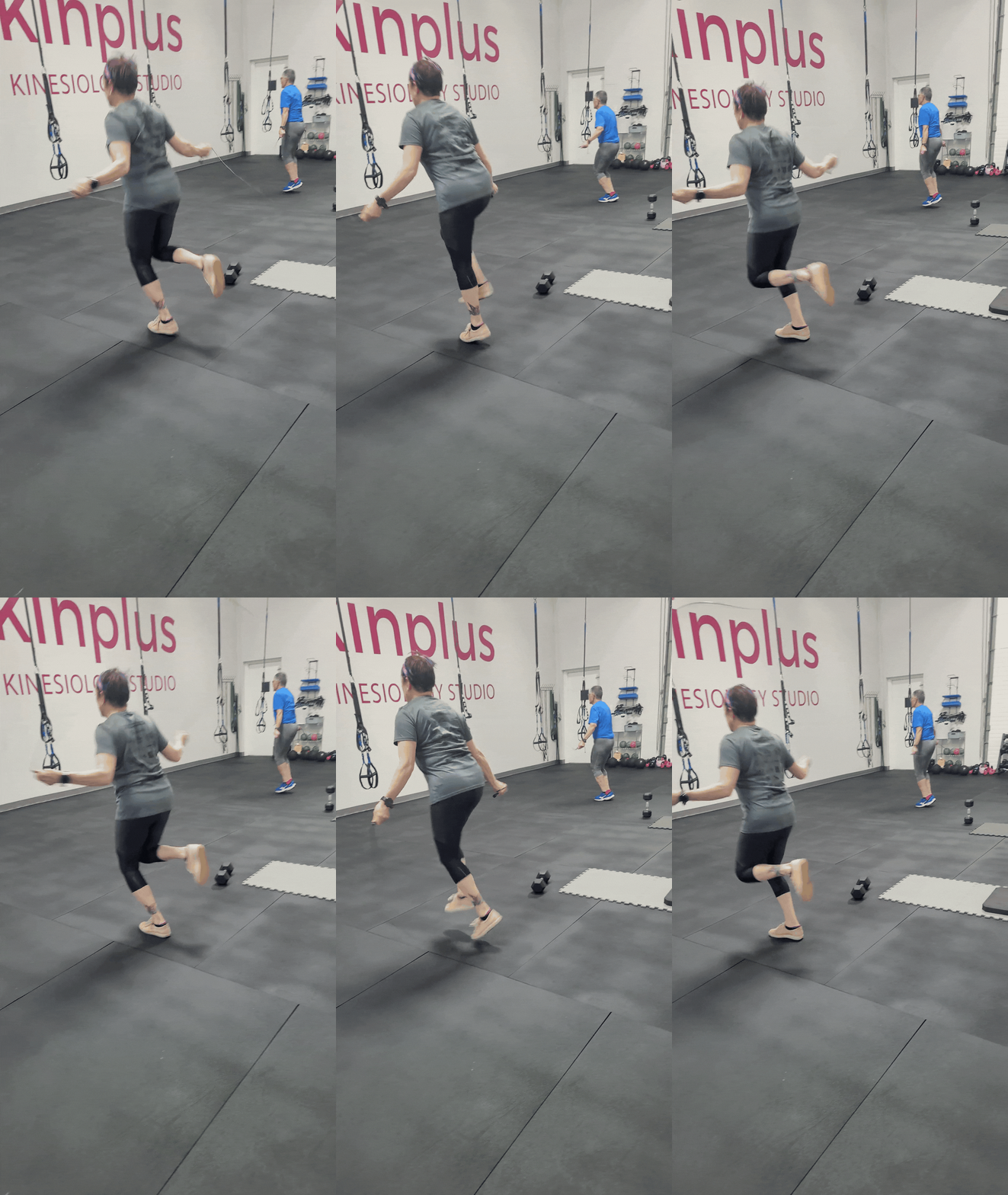
I saw a headline this week that made me stop and smile: "Experts say jumping rope is more effective cardio than running."
As a runner, my first instinct was to defend my sport! But then I took a step back. We see these headlines all the time.. the idea that fitness is a contest, and we have to pick the single "winner" to get in shape.
But if you want to run faster, feel stronger, and stay injury-free, we shouldn't be picking sides. We should be blending them.
I like to think of training not like baking a layer cake (where everything is separate), but like making a soup. The running, the lifting, and the jumping all simmer together to create something better than the individual ingredients.
To show you what I mean, let's look at Jakob Ingebrigtsen. He’s one of the best runners in history, and he definitely doesn't choose between running and strength. He does both, and his approach is surprisingly simple.
The "Secret" is Simplicity
Jakob puts it perfectly: "Strength is a big part of staying injury-free... It's very important, but it's also very important that it doesn't compromise the running."
He doesn’t lift to become a bodybuilder; he lifts to build a chassis that can handle the engine of his running. And the best news? You don't need a complicated Olympic lifting routine to do it.
Jakob’s Strength Menu:
He hits the gym twice a week (usually Fridays and Sundays) and sticks to the basics, focusing on moving the weight with control rather than just heaving it around.
Quarter Squats (8 Reps)
Lunges (6 each leg)
Step-Ups (6 each leg)
Calf Raises (8 Reps)
Romanian Deadlift (6 Reps)
See? No magic tricks. Just consistent, honest work that keeps him train and perform when it matters.
Plyometrics: The Seasoning
Now, let's circle back to that jump rope article.
Jumping rope is a form of plyometrics (bouncing exercises). If running is the broth and strength work is the vegetables, plyometrics are the salt and pepper. A little bit makes the soup perfect. But if you dump the whole shaker in? You ruin the dish.
That headline suggested swapping your run for jumping rope. A better approach is to sprinkle the jumping into your routine. But you have to be careful.
Expert coach Vern Gambetta reminds us that not all jumps are created equal. He actually created a "Stress Rating Scale" for these movements:
Level 1 (Low Stress): Jump rope, ankle bounces.
Level 5 (Very High Stress): Depth jumps or "Shock" jumps.
I often see clients wanting to Level 5 before they have mastered or developed Level 1. This goes along with one of my favourite Vern quotes: "You can't extend a capacity you don't have."
High-stress jumps are inappropriate for beginners, they require a massive base of strength and skill first.
The Takeaway: Start with the "Level 1" stuff, like that jump rope, and prioritize quality over duration. A recent study supports using short, 10-second bouts, which aligns perfectly with the philosophy of legendary coach Renato Canova. Canova warns against the common Western mistake of "qualifying the extension" meaning we try to go long too soon and hope the quality catches up. Instead, he preaches the "extension of quality." Master a short 10-second interval first, then simply add more of those intervals rather than making the interval longer. You want to stimulate your nervous system, not exhaust it.
"You must be fast enough, you must have endurance. So you run fast for speed and repeat it many times for endurance." -Emil Zátopek
Let’s Make Some Soup
Jakob Ingebrigtsen changes his recipe depending on the season more strength in the winter, more speed in the summer. He treats his body like a whole system, not a collection of parts.
So, don't worry about finding the exercise that is "better" than running. Keep running. Add the simple strength work. Sprinkle in the jump rope.
Mix it all together and enjoy the results.
Putting It Into Practice
It’s one thing to read the recipe, but another to actually cook the meal.
This framework: balancing the running, the lifting, and the plyometrics is exactly how I structure our Group Classes and 1-on-1 Coaching: For example: hopping series, stationary hops, squat jumps, jump shrugs, broad jumps, horizontal jumps. I teach this because it keeps runners healthy and durable for the long haul.
You absolutely can (and should!) try these adjustments on your own. But if you ever feel stuck on the "how" or just want a guide to make sure you're doing it right, I'm always here to help.
Resources & Downloads
Want to dive deeper into the science? Here is the guide on plyometrics mentioned above:
References:
Article Inspiration: Experts say jumping rope is more effective cardio than running (The Independent)
Minimalist Dose Study: Plyometric training improves running economy (Nature Scientific Reports)
Plyometrics Guide from Vern Gambetta:



Comments